
The Five Hard Truths No One Ever Tells You About Digital Transformation in the ERP World
Published: 23.January.2026
⏱️ 7–8 minute read
Everywhere you look today, you will find stories about digital transformation.
They usually highlight a new capability, a successful go-live, or a moment when the organization “rallied together” to deliver change.
These stories are inspiring—but incomplete.
Most ERP and digital transformations succeed or fail for reasons other than technology.
They succeed or fail based on whether leadership understands value realization and has the discipline to govern it long after the system goes live.
Go-live is not the finish line. It is where value risk begins.
My core thesis is simple: ERP and digital transformations are leadership disciplines, not delivery events.
To unlock sustained value, leaders must confront five hard truths that sound simple when listed but are anything but simple when applied inside complex enterprises.
The Five Hard Truths:
You cannot out-innovate weak or ungoverned business processes.
Achieving value is leadership’s responsibility, not a project team’s responsibility.
Before unpacking these truths, pause and reflect:
How does your organization define “value”?
How does your CFO define it?
How does your COO define it?
How does your board define it?
Value may show up as working capital improvement, cost-to-serve reduction, faster decision-making, improved forecast accuracy, reduced risk exposure, or organizational resilience. If leaders are not aligned on what value means, no amount of execution excellence will deliver it.
Alignment on value is often the true holy grail of ERP transformation.
Go-live is the Lowest-Value Moment
At go-live, organizations usually celebrate one thing: The system works.
But value realization does not begin with “working software.” It begins with how the organization evolves after deployment. In the days post-go-live and often for months afterwards, value is at its lowest point.
Value is at its lowest point because the focus of value is narrowed:
The Solution is Stood Up
Legacy Systems are Replaced.
Basic Business Processes Work
Stabilized Operations
It is necessary to Go-Live, but it is not where ROI is earned. It is where potential ROI is created.
Yet most organizations mentally declare victory and hang the mission accomplished banners.
This is where the stall begins, and value is never truly realized.
Activity is not progress nor is it value.
The cracks begin to form here, in realizing that value is not being created as activity is executed.
Why?
Simple value realization has plateaued, and the enterprise feels stuck.
Because all activity is focused on local gain, not enterprise gain:
Single-Process Improvement
Department-level efficiencies
Feature adoption without understanding the impact.
The solution is being used but not leveraged.
From a stakeholder perspective, this often shows up as:
“We invested a lot, but benefits feel incremental.”
“We improved some processes, but nothing changed end-to-end.”
“Everyone is busy, but the business isn’t materially different.”
This is not a technology failure of project team failure. It is a leadership gap.
Simplification unlocks Value
Value creation and acceleration begin when the enterprise starts to understand simplification.
This is often where organizations stop asking: “How do we improve this process?” and start asking, “Why does this process exist at all?”
Simplification is uncomfortable because it forces hard conversations and inward reflection, requiring leadership to look in the mirror. The conversations should center around the following:
Standardization vs. Customization
Global Process Ownership
Data Model Maturity and Discipline
Removing “important” work that adds no enterprise-wide value.
This is also where transformation debt becomes visible, not just technical debt.
Process Debt
Data Debt
Integration on top of Integration
Workarounds masquerading as “business flexibility.”
Every exception allowed during the transformation shows up here with interest. The payment is finally due!
Leadership that avoids simplification often mistakes complexity for capability. Complexity is the tax on speed, quality, and scalability.
You cannot out-innovate weak or ungoverned business processes
Executives must understand that the solution/ERP is no longer “an IT system.” The solution is enterprise infrastructure.
This is when digital transformation leadership truly begins to show up, but why?
Simple
Executive Sponsorship must be sustained beyond the Go-Live
Executive Sponsorship drives clear accountability for value, not just delivery.
Executive Sponsorship must unlearn legacy behaviors and turn off legacy systems.
Executive Sponsorship investments become anchored on outcomes, not features.
This is the moment where value compounds or it disappears.
Unfortunately, most organizations again see activity as progress and rush into new projects.
New Modules for Capabilities
Adjacent Software Solutions
Advanced Analytics
Automation and AI
This expansion is dangerous if value creation is not institutionalized.
It creates the following without proper governing:
More Integrations
More Exceptions
More Dependency on Heroics
More Technical and Transformational Debt
Leadership must understand this hard truth: You cannot out-innovate weak or ungoverned business processes.
Value is only created when the core is simplified, processes are governed and institutionalized, and there is trust in the results.
Achieving value is leadership’s responsibility, not the project teams.
Digital transformation is not a technology or project team’s role. This is why modern digital transformation leadership looks different from what it did in the past.
It is no longer just about:
Delivering Project
Standing up Platforms
Chasing the Next Tool
It is about:
Governing value realization over time
Managing technical and transformational debt explicitly
Sequencing change to compound benefits, not compete for attention.
Treating ERP and core systems as strategic assets
The most effective CIOs and transformation leaders do not ask: “Did we go live on time?” They ask: “Where are we on achieving true value, and what is preventing us from gaining more value?”
Achieving value is leadership’s responsibility, not the project teams.
Who is responsible then?
Well-seasoned project managers use the RACI in their project setup to clarify who is responsible, who is accountable, who needs to be communicated with, and who needs to be informed. A RACI works so well in a project environment because the deliverables are defined, the objectives are clear, and everyone is working toward the same goal.
Would creating a RACI for leadership help clarify their responsibilities in achieving value?
The simple answer is no, because achieving value requires leadership behavior changes. However, there is a probing question a leader can use to help them understand where they are on the journey. “Where is the enterprise actually at in achieving value, and what leadership behavior is required to move forward?”
The reason this question resonates so well is that the answer is rarely technical after the initial implementation. And the answer is never another tool implementation.
Value is not a one-time event. Value is not a phase. It is a leadership discipline.
Organizations and leaders who understand this concept begin to understand that you do not transform once. You must build the capability to transform repeatedly as a core component of the organization. Like riding a bike, as the organization transforms, it continues to work on transformation through behavioral changes in leadership. The transformations become bigger, with less risk and yielding higher returns.
Executive Lenses
A CEO Lens: Enterprise Value, Not Enterprise Activity
ERP exposes whether an organization can operate as a system or remains a collection of functions. When value does not materialize, the issue is rarely technology. It is leadership alignment.
The real CEO question is not, “Did we deliver the program?”
It is, “Did we change how the enterprise operates, decides, and creates value?”
A CFO Lens: Why Value Leakage Is a Financial Problem
When value realization is not governed, ROI erodes quietly through delayed benefits, rising run costs, and increased risk exposure. ERP is not a technology program—it is a balance-sheet and cash-flow lever.
A COO Lens: Where Value Lives or Dies Operationally
ERP value shows up—or fails—to be seen on the shop floor, in planning outputs, and in daily execution. When simplification is avoided, operations incur costs through workarounds, expediting, and increased risk.
A CIO Lens: From Delivery Owner to Value Architect
The CIO’s accountability begins after go-live. Modern CIOs are not system owners; they are orchestrators of value across people, process, data, and decision rights.
Platforms are delivered, but outcomes are assumed.
Process ownership is unclear or fragmented.
Data quality issues are tolerated as “business realities.”
Technical and transformation debt accumulates without visibility.
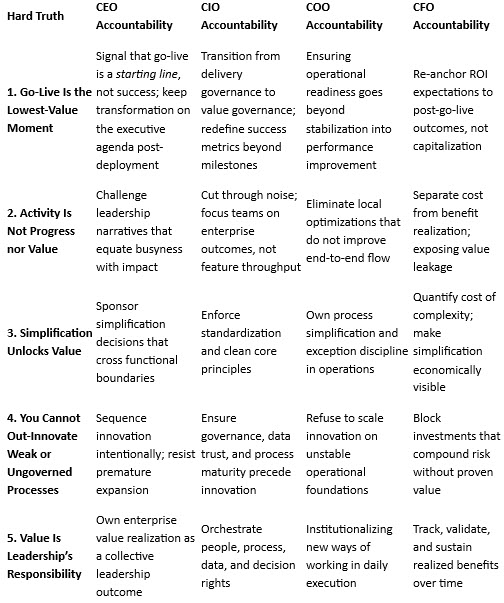
What Comes Next: Building the Capability to Realize Value
Understanding these hard truths is only the first step.
The harder question is:
How do leaders operationalize value realization after go-live?
In my next article, I will introduce the Value Realization Framework—a practical leadership model designed to:
Assess where an organization truly is on its value journey.
Identify where value is stalling and why.
Clarify the leadership behaviors required to move forward!
Shift ERP from a delivered asset into a compounding value engine!
Organizations that master this capability do not “transform once.”
They build the muscle to transform repeatedly—faster, with less risk, and with greater returns each time.
If this resonated, the next article introduces a practical Value Realization Framework designed to help leaders diagnose where value stalls—and what to do next.
Until next time.
Connect
Reach out anytime for questions or mentoring.
nlj1978@gmail.com
+1-317-292-1357
© 2025. All rights reserved.